GetAPro LLC
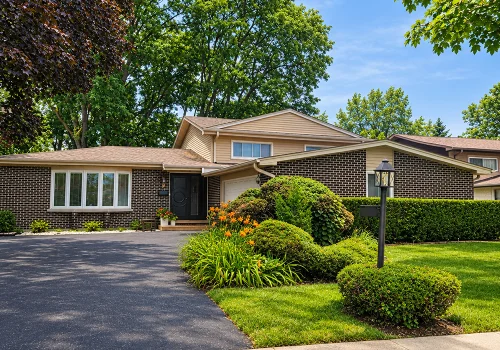
This full home inspection covered an older brick ranch home (built before 1978) in Arlington Heights, IL. Of the 72 components inspected, our team documented 48 total findings: 24 recommendations, 12 maintenance items, and a notably high 12 safety hazards. The garage door wasn't self-closing and its safety sensors were mounted too high, the walkway was sinking and flagged as a trip hazard, and back stairwell handrails were missing. Electrical findings were extensive: a corroded service lateral pedestal, a missing grounding rod, and GFCI protection missing at multiple locations.
Exterior
A walkway was found sinking and flagged as a trip-hazard safety concern, worth leveling or repairing promptly. Driveway cracking and plantings too close to the foundation were also noted, along with cracks in a retaining wall. On the back stairwell the handrails were missing - a safety hazard, since a properly graspable handrail is a basic fall-prevention feature.
Roofing/Vents/Attic
Lifted shingles and roof sag/waviness were noted in the covering itself, echoed by a separate structural finding of roof sag in the framing below - worth having a roofer and, if needed, a structural professional evaluate together, since sag visible from both the surface and the structure below is more significant than either alone. The chimney flue was cracked, flashings were lifted/separated and showed corrosion, and attic ventilation baffles weren't visible.
Garage
Two related findings here: the garage occupant door was not self-closing, and its photoelectric safety sensors were mounted too high to reliably detect low obstructions - both flagged as safety hazards. A self-closing door is a key fire-separation feature between an attached garage and the living space, and correctly positioned sensors are what stop the door from closing on a child, pet, or object in its path. Garage door trim also showed cosmetic damage.
Kitchen Components and Appliances
The range/stove was missing its anti-tip bracket - a safety hazard, since without it a loaded oven door can cause the appliance to tip forward.
Interiors
Window and door screens were damaged or missing, and a bedroom door was misaligned. Missing grout and/or sealant was noted in the walls.
Bathroom
A sink was cracked and drained poorly, and tiles were cracked. Corrugated drainage connections were also found.
Fireplace
The gas-starter fireplace had no gas key present, damper door operated normally. A chimney sweep/Level 2 inspection was recommended as routine maintenance.
Plumbing
The water heater is an older unit and was found missing its electronics board cover - worth having a plumber replace, since the cover protects the unit's control electronics from dust and moisture. The sump pump pit was dry at the time of inspection (a normal, not necessarily concerning, observation depending on recent weather).
Heating
An exhaust vent was not properly sealed - worth correcting to ensure combustion gases exhaust safely to the exterior rather than escaping into the surrounding structure.
Air Conditioning
The cooling equipment is due for regular maintenance; it was tested and operated during the inspection. Ductwork in the distribution system was found partially or fully non-insulated.
Electrical
This home's electrical system carried the largest cluster of safety hazards in the report. The service lateral pedestal/meter socket showed corrosion and damage, and no grounding rod was found at the service entrance - both safety hazards, since proper grounding and an intact service connection are fundamental to the whole system's safety. GFCI protection was required and missing at two separate locations, and a non-GFCI exterior receptacle was found with an open ground - three more safety hazards, since exterior and wet-adjacent outlets carry elevated shock risk without proper protection. Exposed or missing bulb covers on connected fixtures, and a smoke detector with a missing battery, rounded out the safety findings - the smoke detector in particular is worth fixing immediately, since a battery-less detector provides no protection at all. Less urgently, the grounding rod should sit about 4 inches above ground level, the panel is improperly labeled and has limited access due to being embedded in wood paneling, an outlet was found with hot and neutral reversed.
Structural Components
Efflorescence (the white, chalky mineral deposit left behind as water evaporates through masonry) was noted at the foundation, which had been previously repaired in at least one area.