GetAPro LLC
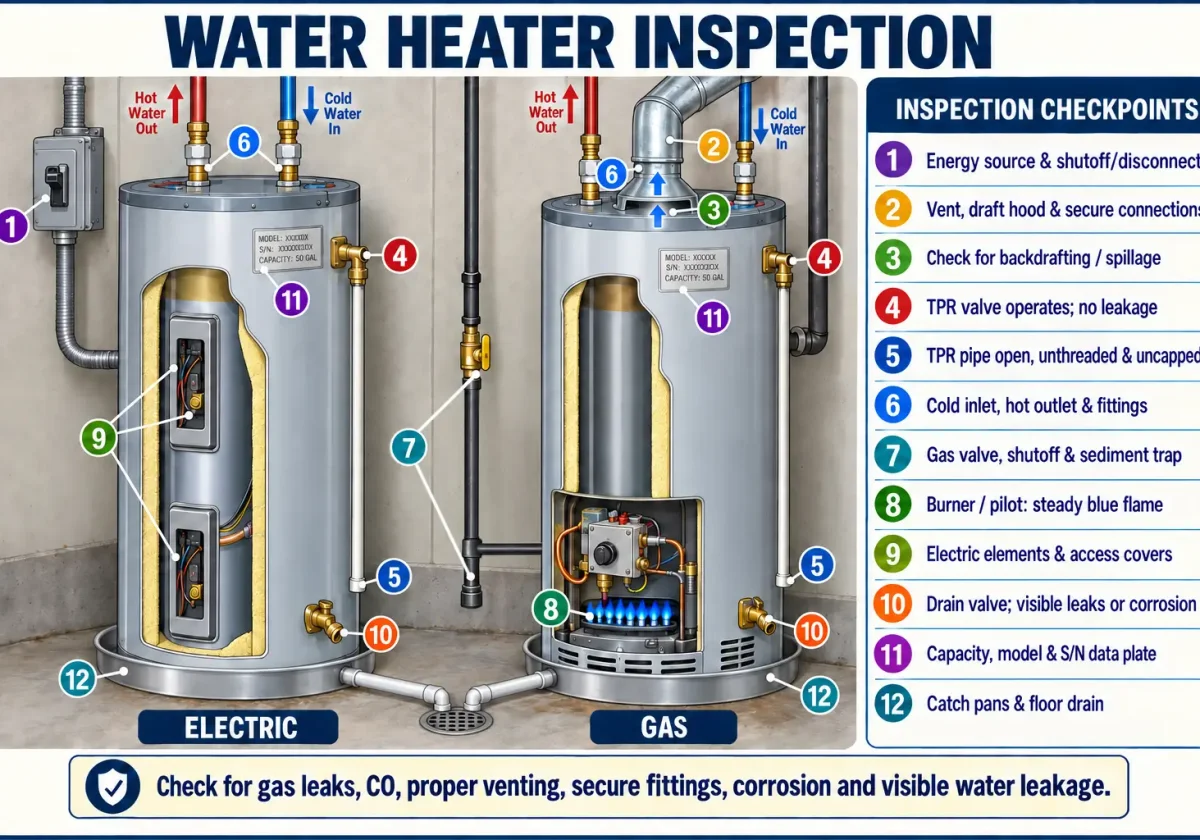
The water heater is one of the most overlooked systems in a home until it fails, but it's also one of the systems most likely to have a code-significant safety defect, particularly around the temperature and pressure relief valve. As Chicago home inspectors, we check both gas and electric water heaters at 12 key points on every inspection. Here's what we're looking for and why it matters.
Energy Source and Shutoff
Every water heater needs a way to be shut off quickly. On gas units, that's a gas shutoff valve mounted near the tank, easily reachable, with a sediment trap (drip leg) in the line just before the gas control valve to catch debris and moisture before it reaches the valve. On electric units, it's a dedicated disconnect or double-pole breaker, properly labeled and accessible. We confirm the right shutoff is present and working for the fuel type, since it's the first thing anyone needs to find in an emergency.
Venting and Combustion Safety (Gas Units)
Standard atmospheric gas water heaters vent through a draft hood into a vent pipe that should slope upward the entire way to the flue, with sections screwed together rather than just friction-fit, and no gaps or rust-through at the joints. Power-vent units route exhaust mechanically instead and have their own clearance and termination requirements. We check for backdrafting and spillage at the draft hood after the burner has been running, since combustion gases spilling back into the mechanical room or closet instead of venting outside is a carbon monoxide risk.
Temperature and Pressure Relief (TPR) Valve
The TPR valve is the single most important safety device on a water heater, and it's also one of the most commonly installed incorrectly. It has to be rated for the tank it's protecting and installed in the correct location. Just as important is the discharge pipe: it needs to run down to within a few inches of the floor (or to an approved termination point like a floor drain), stay open and unthreaded at the end, and never be capped or reduced in size. A capped or upward-facing discharge pipe defeats the entire purpose of the valve, since it would direct scalding water and steam into the room, or the tank itself, in an overpressure event instead of safely away from anyone nearby.
Water Connections and Fittings
The cold water inlet and hot water outlet should be properly connected with fittings rated to prevent galvanic corrosion between dissimilar metals, and a shutoff valve should be present on the cold inlet so the unit can be isolated for service. We look for corrosion, mineral buildup, or active leaks at every fitting, and check that an expansion tank, when one is present, is properly installed and supported rather than just hanging off the pipe.
Electrical Elements (Electric Units)
On electric water heaters, we check the upper and lower heating element access covers, confirming insulation is present and wiring connections are secure with no exposed or damaged conductors. We also confirm the unit is on a dedicated circuit with a correctly sized breaker, since an undersized or shared circuit is both a performance issue and a potential fire hazard.
Drain Valve, Corrosion, and Leaks
The drain valve at the base of the tank should be present and functional. We look closely at the base, legs, and seams for rust, corrosion, or staining, since a slow leak at the tank seam is often the earliest visible sign that a water heater is approaching the end of its service life well before it fails outright. Water staining on the floor around the unit is one of the most common tells, even when the leak itself is no longer active at the time of inspection.
Capacity, Documentation, and Secondary Containment
We photograph the model, serial number, and capacity on the data plate, since the serial number typically encodes the manufacture date and helps estimate how much service life is left. Most residential water heaters last 8 to 12 years, so documenting the age is useful context even when the unit is functioning fine today. In locations where a leak could cause real damage, like an attic, a finished space, or above living areas, we also confirm a catch pan is present and properly piped to an approved drain rather than just sitting under the tank with nowhere for water to go.
Why This Matters
A water heater doesn't get much attention until it stops working or starts leaking, but several of the items on this list, especially the TPR valve and its discharge pipe, are code-required safety features, not just maintenance items. Most of what we find is minor: a missing drain pan, a corroded fitting, a capped TPR discharge pipe left over from a DIY install. But on occasion we find units with active leaks, cracked tanks, or venting problems serious enough to recommend replacement or further evaluation before the home changes hands.